
The Nth Product Costs Less Than the First

The Compound Startup Thesis, Re-Checked
A few months ago, we made a claim:
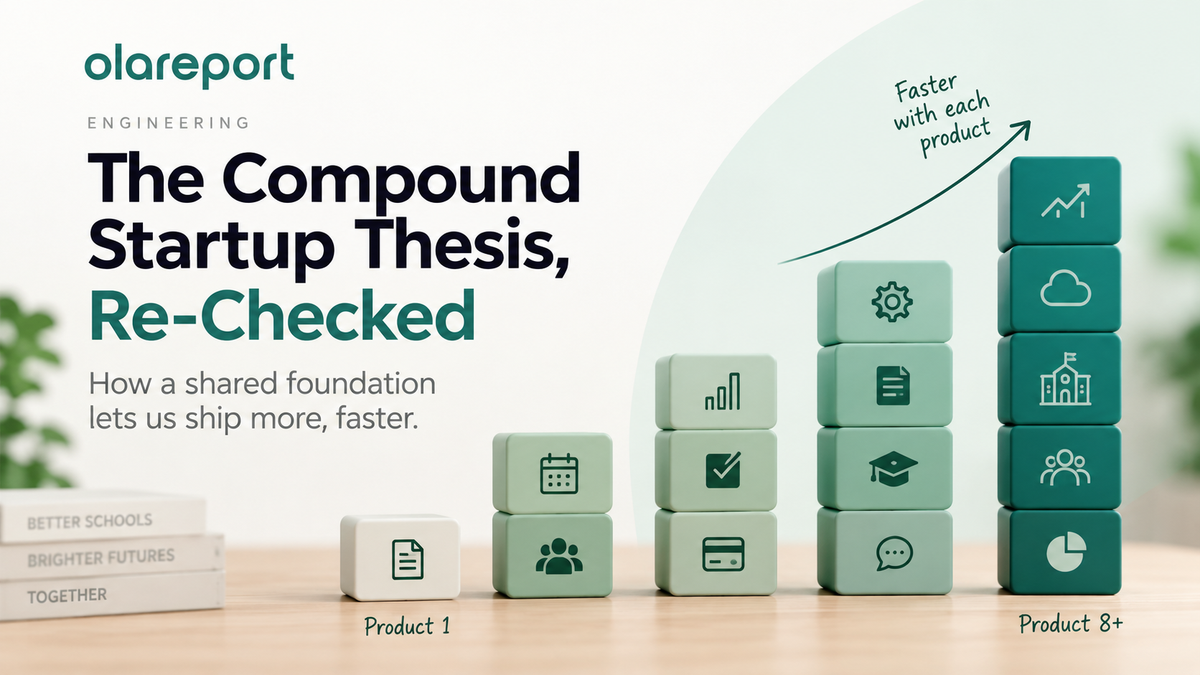
A company that gets this right ships its eighth product faster than its first.
Seven months and several products later, we went back to see if that was actually true.
It was.
But not quite for the reason you might expect.
The first product pays the tax
Olareport's first major product was report cards.
Building it meant building much more than report cards.
We needed identity, permissions, storage, notifications, background processing and the basic concepts that describe how a school operates.
None of those things were the product. But the product couldn't exist without them.
That's the tax the first product pays.
The interesting thing is what happens afterward.
The next product inherits
After report cards came attendance, fees, assessments, learning spaces, certificates, curriculum tools and more.
Each product was different, but many of its underlying problems weren't.
A certificate product still needs to know who the user is.
A fee system still needs permissions.
A curriculum workflow still needs storage and notifications.
Instead of rebuilding those capabilities inside each product, they inherit them from the platform.
So the engineering question gradually changes from:
How do we build everything required for this product?
to:
What is actually unique about this product?
That difference compounds.
Product N should make Product N+1 cheaper
This has become one of our most useful ways of thinking about Olareport.
Product N should leave something useful behind for Product N+1.
Sometimes a new product exposes something the platform cannot do.
We can solve that problem specifically for the product, or ask whether the missing capability belongs in the underlying platform.
When the latter is true, we improve the foundation.
The current product gets what it needs.
The next product inherits it for free.
That is what compounding looks like in software.
Not maximum code reuse. Not abstraction for its own sake.
Just progressively less infrastructure to rebuild.
It doesn't work everywhere
The effect is strongest on the backend.
Interfaces are different.
A fee ledger doesn't look like a curriculum review screen. A report card doesn't behave like an assessment workspace.
Shared components help, but every new product still needs its own experience.
So the thesis isn't that every new product becomes nearly free to build.
It's that the amount of infrastructure we have to rebuild keeps shrinking.
That leaves more engineering time for the parts customers actually care about.
Why this matters
Schools don't care how Olareport's backend is structured.
They care about what that structure allows us to do.
When a school asks for something new, we're increasingly not starting from zero.
We're extending a system that already understands schools, users, permissions, communication, documents and workflows.
That affects how quickly we can respond, how broadly we can build and eventually how we can price the platform.
Seven months later, I'd slightly rewrite our original claim:
A company that gets the foundations right ships its eighth product faster than its first because the first seven products left something behind.
That's the bet behind Olareport.
The goal isn't simply to keep shipping more products.
It's to make sure every product makes the next one easier to build.


 Download App
