
We Won on Report Cards, Then Compounded

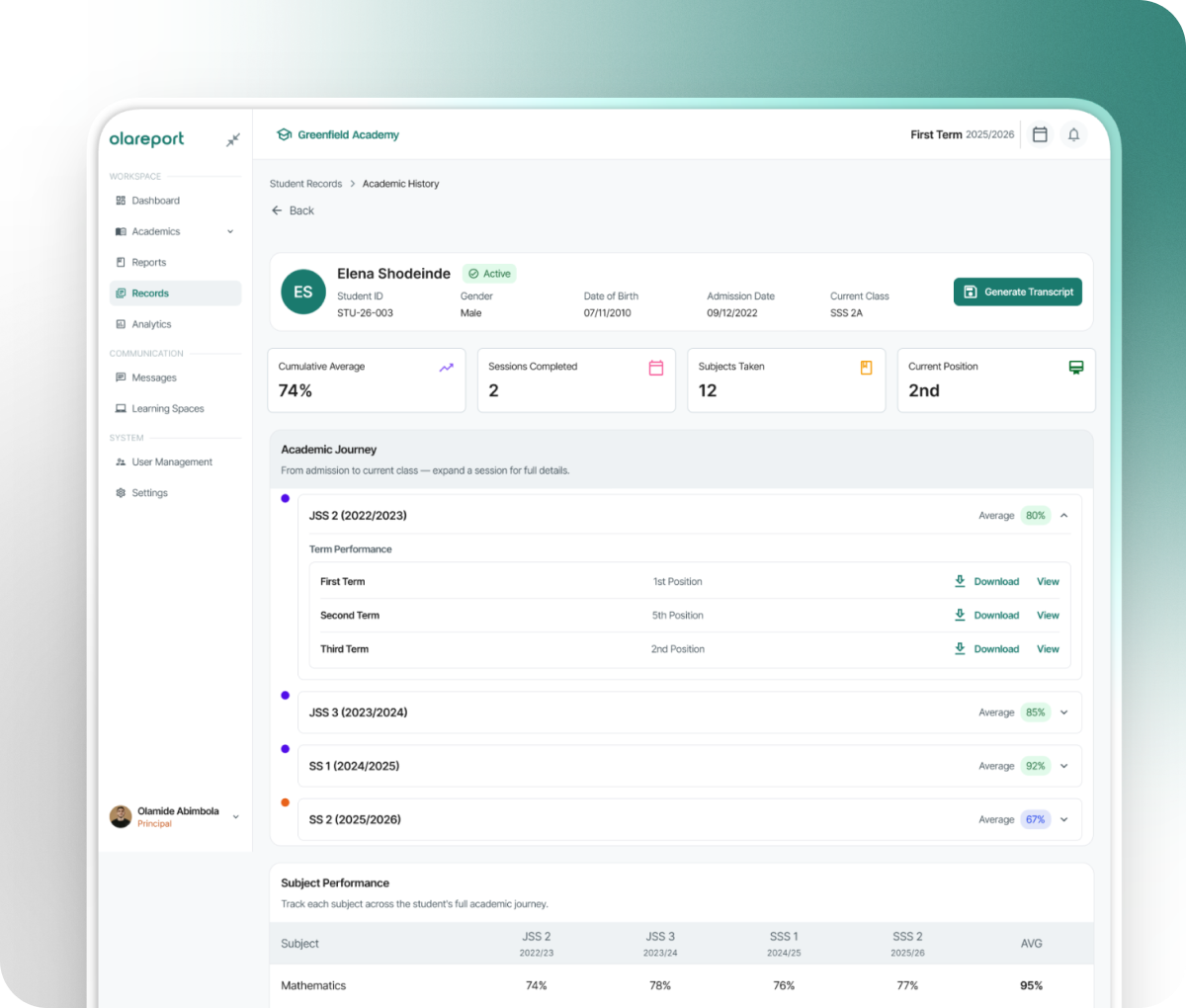
Olareport did not start by trying to solve every problem in education.
We started with one problem schools felt deeply: report cards.
For many schools, the end of a term meant days of spreadsheets, manual calculations, repeated corrections, formatting, printing, and administrative pressure. Teachers were exhausted. Administrators were chasing results. Small mistakes could delay an entire school.
So we focused on making that experience dramatically better.
And it worked.
When we look at what our customers say about Olareport, report generation comes up again and again. Schools talk about the time they save, how much easier results are to manage, and how a process that once consumed days can become routine.
That was our wedge.
Earn the Right to Build More
There is a temptation when building software for schools to start with everything: attendance, fees, messaging, lesson notes, admissions, exams, analytics, and dozens of other features.
But having more features does not necessarily make a product more valuable.
We took a different approach: solve an important recurring problem extremely well, become part of the school's workflow, and expand from there.
Once a school manages report cards on Olareport, something important happens.
We already understand its students, classes, subjects, teachers, academic sessions, terms, and results. That same foundation can power much more.
Report cards lead naturally to continuous assessment and exams.
Student records make attendance easier.
Teacher and class information supports lesson notes and classroom workflows.
The same identities and relationships make parent and school communication more useful.
Each new capability does not have to exist as another disconnected piece of software. It compounds on the infrastructure already there.
One Student, One Continuous Record
This is where the bigger Olareport vision begins.
A student's report card should not be an isolated PDF produced three times a year. It should be one view into a continuously growing educational record.
Attendance, assessments, teacher observations, academic performance, communication, transcripts, and eventually other parts of the student's journey can build on the same underlying record.
For schools, that means less duplication and fewer disconnected systems.
For us, it means we do not have to win every workflow on day one.
We earn the right to expand.
Report cards gave us the wedge. Our customers showed us where to go next.
And now we compound.


 Download App
